
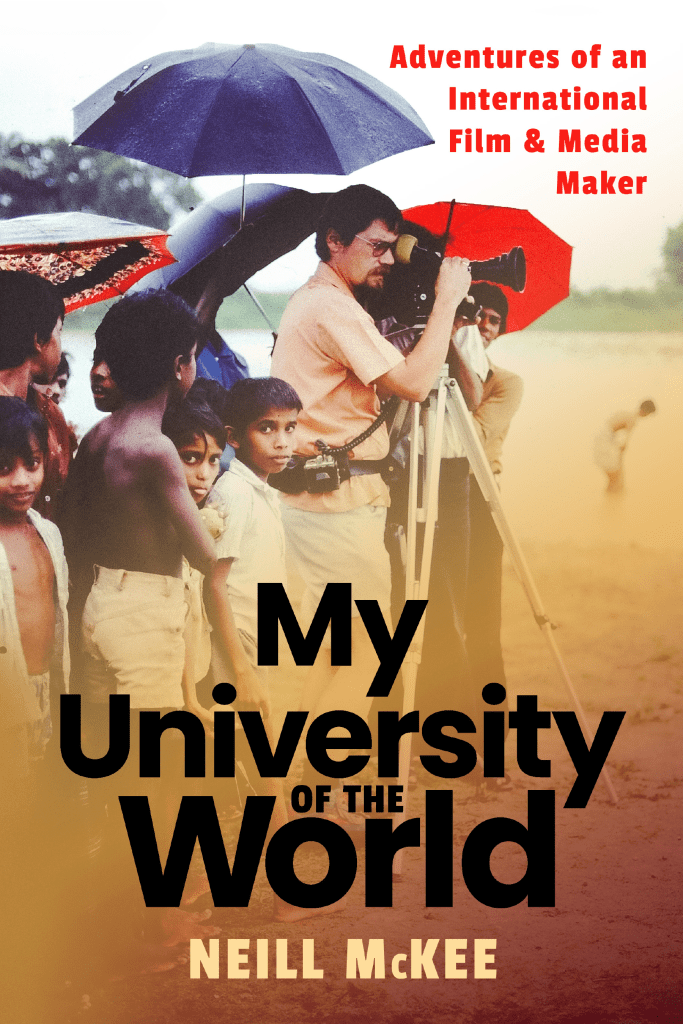
Neill McKee has taken me along on his journey in, My University of the World. His travels extend beyond those of many readers—North America, South America, Asia, Africa, and the list goes on. But this is more than a travel guide. It is a story about humanitarian efforts extended to the people of developing countries by an army of volunteers, and what can be learned from various cultures. Those volunteers provide resources and training to aid in the development and growth of areas in poverty, especially rural areas, while respecting the customs and traditions of inhabitants. Some of the life challenges experienced are unfathomable to someone like me who doesn’t get out much. So, what’s great about this book is I can try to understand other civilizations while sitting in my favorite chair.
The author is a filmmaker, capturing videos and photos (many included) of the work extended to underdeveloped countries. Those volunteers are educators, medical professionals, technologists, agriculturalists, and all-around life-giving humanitarians. McKee gets up close and personal to film them in action—educating villagers about nutrition, sanitation, and hygiene. They advise farmers on securing adequate food storage methods to prevent waste. Technology is introduced, for example, to help make life a little easier for African women.
Of the many interesting anecdotes shared by McKee, one of my favorites involves the teaching process in primary schools in the Philippines. The typical classroom structure is replaced with a comfortable environment where students are divided into small groups for peer-to-peer learning. A teacher is there to assist, but there is less pressure on the process, so children are inspired to learn.
There are plenty more anecdotes, some of them humorous and others eye-opening. Throughout, the reader will experience a good dose of history, geography, and also learn a little about what goes into good filmmaking. I was able to relate with much of this as it spans the time period when I was coming of age in the 70’s and beyond—the music, the styles, and “pre-internet” survival. I was familiar with the segment on copper mining as I grew up in a copper-mining environment. The farthest place I’ve traveled is Africa where my daughter studied for a semester, so the stories told there were of particular interest to me.
This book has a little bit of everything through its nearly 500 pages—even romance! McKee shares the love story of meeting his wife, Beth, and how they survived a long-distance relationship and engagement by communicating mostly via snail mail. Beth introduces herself to Neill’s parents in a letter, I believe while she was living in Japan, with a poem and drawing. They immediately loved her. And finally, the reader meets the McKee children, who have lived this life of adventure and have become successful adults.
So, when you are ready to take a trip around the world while being entertained, pick up this book and dive in. You can also learn more about the author at: www.NeillMcKeeAuthor.com.
 Writer Leslie Cox